
 |
| UK Police Constable Gift Coffee Mug to Personalise... |
The history of policing in the United Kingdom is a fascinating journey that charts the development of a public institution from informal watchmen and parish constables to today’s diverse, professional police services.

From Sir Robert Peel’s foundational reforms in the 19th century to the inclusion of women officers, and from the Victorian detective to the body camera-clad officers of today, the police have played a central role in British public life.
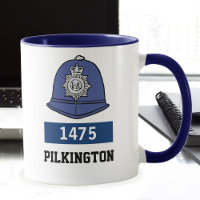
This article explores the major milestones in the evolution of UK policing, with links to several museums and archives where you can explore this remarkable history for yourself. The product images that are included are all items that have been designed by me, and which are available to buy online from my Zazzle store.
The Beginnings of Modern Policing
In 1829, Home Secretary Sir Robert Peel introduced the Metropolitan Police Act, establishing the Metropolitan Police Force for London. This was the first organised police service in Britain, designed to be an unarmed, civil force with a focus on preventing crime. Officers became known as 'Bobbies' or 'Peelers' after Sir Robert himself.
Peel's principles of policing - emphasising crime prevention, public approval, and minimal use of force - still influence British policing philosophy today. The early force was based at Scotland Yard and initially met with suspicion, but it gradually gained public trust.
 |
| Explore My Collection of Police Themed Gifts and Cards >> |
The Bow Street Runners and Early Law Enforcement
Before the Met, there were earlier attempts to formalise policing. The most famous of these were the Bow Street Runners, established in the mid-1700s by magistrate Henry Fielding in London. These men were not police officers in the modern sense, but they were paid to detect and apprehend criminals, marking a move toward organised law enforcement.
The Bow Street Police Museum is housed in the original police station and magistrates’ court. It’s a wonderful place to discover the roots of British policing and hear stories of notorious cases and early methods of investigation.
Uniforms, Equipment, and the Evolution of Image
Early Metropolitan Police officers wore blue uniforms to distinguish themselves from the red of the military. The helmet, introduced in the 1860s, became a lasting symbol of British policing. Officers were equipped with wooden truncheons and hand-held lanterns. Many of these historic items can be viewed at the Metropolitan Police Heritage Centre.
Uniforms continued to evolve through the Victorian and Edwardian periods, reflecting changes in society and technology. Some rare examples, including Victorian-era tunics and early police call boxes, are preserved at the Greater Manchester Police Museum.
The Rise of Detectives and Specialised Units
Detective work began to gain prominence with the formation of the Detective Branch in 1842, which later became the Criminal Investigation Department (CID). Detectives focused on solving complex crimes like fraud, murder, and organised theft, often working undercover and using informants.
The infamous Crime Museum (formerly known as the Black Museum) at Scotland Yard was developed in the 1870s as a private collection of criminal paraphernalia used for training detectives. Though not open to the public, some artefacts from the museum have been displayed in public exhibitions, such as those held at the Museum of London.
 |
| View More from my Gallery >> |
Women in Policing
Women entered British policing in the early 20th century, initially in voluntary roles. Edith Smith became the first woman police constable in the UK with full powers of arrest in 1915, working in Grantham. Her primary duty was to deal with cases involving women and children during wartime.
In 1919, the Metropolitan Police officially appointed female officers, including Lilian Wyles, who later became one of the first female detectives. Their presence grew over time, though full equality took decades. By 2020, women made up over 30% of police officers in England and Wales.
The story of women in the force is explored in several police museums. The Essex Police Museum, for instance, features exhibits on female officers, including their uniforms and notable cases they helped solve.
Policing Beyond London
Other major UK cities established their own forces in the 19th century. The City of London Police began in 1839 and still operates independently from the Met. The City of London Police Museum, formerly located within the Guildhall Library, offered insight into the force’s unique jurisdiction and notable cases, including involvement in the Jack the Ripper investigation. While this museum is currently closed, you can still view its legacy through archived content and online resources.
Elsewhere, the Glasgow Police Museum in Scotland preserves the history of the world’s first municipal police force, established in 1800. It’s entirely volunteer-run and well worth a visit if you’re in the city.
Police Transport and Technology
Horse-mounted units were an early and enduring feature of British policing, followed by bicycles and eventually motor vehicles. Communication methods also advanced, from whistles to two-way radios, and now digital systems.
The Greater Manchester Police Museum includes an impressive collection of police vehicles and exhibits on forensic development and fingerprinting.
Notable Cases and Their Impact
High-profile cases have helped shape public attitudes toward the police and prompted changes in policy. The unsolved Jack the Ripper murders of the 1880s tested the limits of Victorian policing and remain part of criminal folklore.
Later cases, such as the Great Train Robbery of 1963 and the tragic murder of Stephen Lawrence in 1993, highlighted issues ranging from police innovation to institutional racism. The Thames Valley Police Museum in Sulhamstead contains exhibits on the Great Train Robbery, including evidence from the case.
Policing Today
Modern policing in the UK is shaped by technology, accountability, and community engagement. Body-worn cameras, independent complaints procedures, and diversity recruitment all reflect efforts to improve trust and effectiveness.
Today’s police officers deal with challenges unimagined in earlier centuries -cybercrime, terrorism, and mental health crises - while still patrolling streets and responding to emergencies in communities across the UK.
Remembering Those Who Served
The UK Police Memorial at the National Memorial Arboretum in Staffordshire commemorates officers who died in the line of duty. It stands as a poignant reminder of the sacrifices made by those who serve to protect the public.
In central London, the National Police Memorial near Horse Guards Parade lists the names of over 4,000 fallen officers, with a glowing blue glass beacon that represents their service.
 |
| Visit the Police Gifts and Cards Gallery >> |
Where to Learn More
There are many excellent museums and collections preserving the legacy of UK policing. Here are a few to explore:
- Metropolitan Police Heritage Centre (Sidcup, London)
- Greater Manchester Police Museum (Manchester)
- Essex Police Museum (Chelmsford)
- Thames Valley Police Museum (Sulhamstead)
- Glasgow Police Museum (Glasgow)
Conclusion
The history of the police in the UK is a reflection of the country’s broader social and political evolution. From early night watchmen and the Bow Street Runners to a sophisticated network of regional and national forces, British policing has continually adapted to meet the needs of a changing society.
Whether you're a student of criminology, a history buff, or just curious about how the police came to be, visiting a police museum offers a compelling and often moving insight into the realities behind the badge. We owe much to the men and women who have served and continue to serve in the line of duty.
Learn about the role of a Chiropractor in another of my articles...
If you’ve visited any of these museums or have a story related to British policing, feel free to share your thoughts in the comments below!


No comments:
Post a Comment